

Most people notice it gradually. A knee that aches after a morning walk. Hips that feel stiff getting out of bed. Fingers that resist bending on cold days. Joint pain with age is so common that many people assume it’s just something they have to accept, but that assumption can work against you.
As WebMD’s medical editorial team notes, “creaking knees, hips, and ankles aren’t necessarily normal aches and pains that come with age — your pain might be arthritis.” That distinction matters enormously for how you respond. Understanding what’s actually happening inside your joints as you get older is the first step toward protecting them.
The Biology Behind Age-Related Joint Pain
Cartilage Breakdown: The Central Mechanism
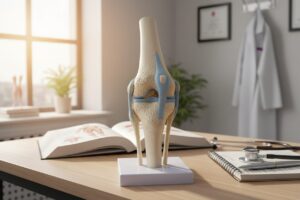
Cartilage is the firm, rubbery tissue that cushions the ends of your bones where they meet at a joint. When it’s healthy, it absorbs shock, reduces friction, and allows smooth movement. When it deteriorates, everything changes.
According to Harvard Medical School research, “osteoarthritis occurs when cartilage in a joint stiffens and begins to break down, which then damages the underlying bone, resulting in pain.” The key word is stiffens. Cartilage doesn’t simply wear away like the sole of a shoe; the molecular structure changes first.
Cartilage is maintained by specialized cells called chondrocytes. With age, chondrocyte activity declines significantly, producing fewer proteoglycans, the molecules that help cartilage retain water and stay pliable. As water content drops, cartilage becomes stiffer and more brittle, losing its ability to distribute load evenly across the joint surface. Over time, the protective layer thins until bone begins making contact with bone.
Compounding this is collagen cross-linking, where advanced glycation end-products (AGEs) accumulate in cartilage tissue over decades. In cartilage, AGEs make the collagen matrix rigid and less responsive to mechanical stress. This isn’t purely mechanical wear; it’s a cellular and biochemical cascade.
Soft Tissue Changes: Tendons, Ligaments, and Muscles
Cartilage gets most of the attention, but surrounding soft tissues play an equally important role. According to the Better Health Channel, “ligaments tend to shorten and lose some flexibility, making joints feel stiff. Many of these age-related changes to joints are caused by lack of exercise.”
Tendons connect muscle to bone and transmit force every time you move. With age, tendon cross-sectional area decreases, collagen fibers become less organized, and water content drops, reducing both elasticity and shock absorption. The result is that tendons transfer force less efficiently and are more vulnerable to overload.
Muscle loss, known as sarcopenia, begins as early as your 30s and accelerates after 50. Orlando Health puts it directly: “Bone and muscle strength deteriorate with age, making it even more difficult for your joints to do their jobs.” A strong quadriceps, for example, acts as an active shock absorber for the knee. When that muscle weakens, the joint bears proportionally more stress with every step.
Proprioception, your body’s ability to sense joint position, also declines with age. This reduces movement precision and increases the risk of awkward loading patterns that accelerate joint wear over years.
Bone Density Loss as a Pain Driver
Arthritis is the most discussed cause of joint pain in older adults, but bone density loss is a frequently overlooked contributor. Osteopenia, the stage before osteoporosis, involves a gradual reduction in bone mineral density. As bone becomes less dense, it grows more susceptible to microfractures, structural stress, and pain under normal loading.
Jefferson Health identifies osteopenia and osteoporosis as leading contributors to joint and bone pain in aging adults, alongside osteoarthritis. Many people experiencing deep joint pain in their hips, spine, or knees may actually have a bone density component that goes undiagnosed because attention focuses on arthritis alone.
A Decade-by-Decade Look at What Changes
Your 30s: Silent Beginnings
Most people feel little to no joint pain in their 30s, but biological changes are already underway. Cartilage hydration begins declining, muscle mass starts its slow descent, and collagen production, which peaks in your mid-20s, gradually slows. These changes are subclinical but cumulative. Injury history, repetitive strain from work or sport, and inactivity during this decade can accelerate the trajectory significantly.
Your 40s: When Symptoms Begin to Surface
The 40s are typically when people start noticing joint stiffness after sitting, reduced morning range of motion, or aching after exercise that never used to cause discomfort. Cartilage has lost measurable water content by this point, ligament flexibility has declined, and muscle strength may be down 10 to 15 percent from peak levels.
As Alexander Orthopaedics notes, “as we age, we tend to lose elasticity and strength in our tendons and ligaments, causing joint motion to become more restricted and less flexible.” The 40s are the decade where preventive action delivers the highest return, because the damage isn’t yet severe and structural changes are still highly modifiable through exercise and lifestyle.
Your 50s and Beyond: Compounding Effects
Joint pain often becomes more pronounced after 50. By this point, cartilage loss may be significant in load-bearing joints like the knees, hips, and lumbar spine. Synovial fluid decreases in quality and volume, and the muscles supporting major joints may have lost 20 to 30 percent of their peak strength without targeted resistance training.
In the 60s and 70s, systemic inflammation often increases due to changes in immune regulation, a phenomenon researchers sometimes call “inflammaging.” This low-grade chronic inflammation contributes to both joint tissue degradation and heightened pain sensitivity.

Osteoarthritis vs. Inflammatory Arthritis: Knowing the Difference
This distinction is one of the most important and most poorly understood aspects of joint pain. UCLA Health summarizes it clearly: “Age-related joint pain stems from years of wear and tear causing deterioration of cartilage, while inflammatory joint pain comes from systemic inflammation attacking joint tissue.”
Here’s how the two typically present:
Osteoarthritis (OA): Develops gradually over years; pain worsens with activity and improves with rest; morning stiffness lasts under 30 minutes; often affects weight-bearing joints asymmetrically, with no systemic symptoms like fatigue or fever.
Rheumatoid Arthritis (RA): Can develop more rapidly; pain and swelling occur at rest and with activity; morning stiffness lasts 45 to 60 minutes or longer; affects joints symmetrically; systemic symptoms including fatigue and low-grade fever are common.
Gout and Pseudogout: Caused by crystal deposits in joints (uric acid or calcium pyrophosphate); often sudden and severe; most commonly affects the big toe, ankle, or knee.
Bursitis and Tendinitis: Involve inflammation of joint-adjacent structures rather than the joint itself; often linked to repetitive use or overload; typically respond well to rest and targeted therapy.
If you’re unsure which type of pain you have, the signs of joint inflammation and how aging affects arthritis risk is worth reviewing before making any treatment decisions.
Evidence-Based Prevention Strategies
Exercise: The Most Powerful Tool You Have
Movement is medicine for joints, but the type of movement matters. Low-impact aerobic exercise, such as swimming, cycling, and walking, maintains joint lubrication without the repetitive impact stress of running. Resistance training builds the muscle that offloads stress from cartilage and bone.
A practical framework for joint protection:
- Resistance training: 2 to 3 sessions per week targeting the quadriceps, glutes, and hip abductors that support the knees and hips
- Low-impact cardio: 150 minutes per week of moderate-intensity activity such as walking, swimming, or cycling
- Flexibility work: Daily stretching or yoga to maintain ligament elasticity and joint range of motion
- Balance training: Single-leg exercises and balance board work to preserve proprioception and reduce injury risk
The goal isn’t extreme fitness. Even modest increases in muscle strength have been shown to reduce knee pain in osteoarthritis patients. Consistency matters far more than intensity.
Weight Management and Nutrition
Every pound of body weight exerts approximately four pounds of force on the knee joint during walking. Losing 10 pounds reduces knee stress by 40 pounds per step, which adds up to a dramatic reduction in cumulative cartilage wear over thousands of daily steps. Weight loss also reduces systemic inflammation, since visceral fat actively secretes inflammatory cytokines that accelerate joint tissue degradation.
On the nutrition side, several nutrients directly support joint tissue integrity:
- Omega-3 fatty acids reduce inflammatory signaling and are found in fatty fish, walnuts, and flaxseed
- Vitamin D supports both bone density and muscle function, two pillars of joint health
- Vitamin C is essential for collagen synthesis; deficiency accelerates connective tissue breakdown
- Collagen peptide supplements have shown modest benefit in some clinical trials for reducing joint pain, though research is ongoing
Anti-inflammatory dietary patterns like the Mediterranean diet have also been associated with reduced OA severity and lower RA activity in observational studies.

Medical and Supplemental Options
When lifestyle changes aren’t enough, several effective interventions exist. Topical NSAIDs like diclofenac gel provide localized pain relief with fewer systemic side effects than oral medications. Intra-articular corticosteroid injections reduce inflammation acutely during flares. Hyaluronic acid injections attempt to supplement synovial fluid, though clinical evidence is variable.
Glucosamine and chondroitin remain among the most widely used joint supplements. Evidence is mixed, but a subset of patients with moderate to severe OA pain do appear to benefit. Physical therapy is consistently effective and often underutilized, particularly for hip and knee OA where targeted exercise protocols have strong clinical trial support.
For those exploring supplement-based support alongside lifestyle changes, our joint health supplement guide covers the most researched options and how to evaluate them.
When to See a Doctor
Most age-related joint stiffness can be managed conservatively, but certain symptoms warrant professional evaluation. Sudden severe pain, significant swelling, joint warmth and redness, pain that wakes you from sleep, or symptoms accompanied by fever or unexplained weight loss all suggest a condition that needs clinical assessment rather than self-management.
Understanding how Harvard-backed research connects molecular changes in cartilage to joint pain progression can also help you communicate more precisely with your doctor about what you’re experiencing.
Joint pain with age is common, but its severity is not inevitable. The biology is real, and so is the capacity to slow it down, manage symptoms, and maintain quality of life well into your 60s, 70s, and beyond.


0 comments